My paintings and films explore visibility, memory and the ways we protect ourselves. Informed by my experience as a queer artist, I’m interested in how we shape what others see of us, and how those ways of being can remain long after the circumstances that made them necessary.
Across both media, I return to the distance between outward appearance and inner experience. My films explore the barriers between being observed and being known. In my paintings, figures are partially erased or painted over, leaving traces that suggest something has happened without making it fully visible. These interruptions connect with the uncertainty of memory: what remains, what changes, and what becomes difficult to recover.
My recent work extends these questions to images of conflict and displacement. Shelter becomes both a physical need and a way of thinking about emotional and spiritual safety, and the consequences of its loss. Working with images encountered through digital feeds, painting allows me to spend time with events that might otherwise pass quickly from view, considering what we remember after the image has gone.
Shelter
Displacement
SAfety
Invisibility
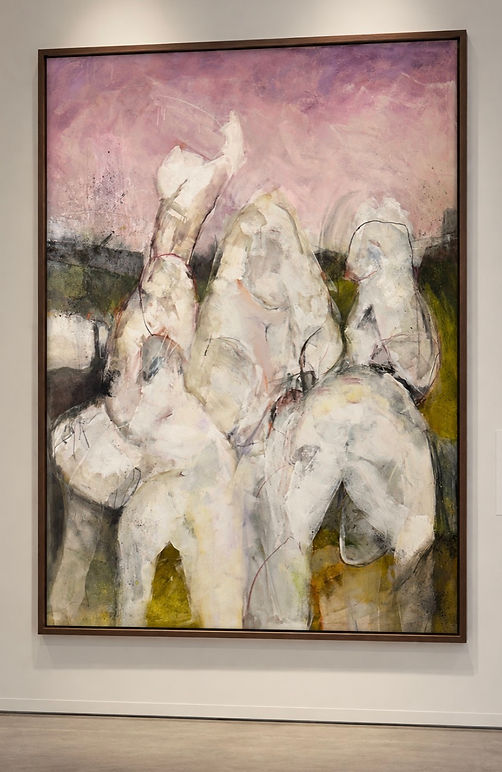
We watched in silence
2026
Acylics on canvas
149 cm × 200 cm
£5,500
From the Shelter series
Figures emerge from a scene in which something terrible appears to be unfolding. Yet the central event has been obscured, whitewashed from view, leaving us to question what has happened, what we have witnessed, and what we have chosen not to see.
The whitewashing becomes a metaphor for the erasure of history, for atrocities concealed, forgotten, or deliberately rewritten. The figures remain, caught between witnessing and silence, their presence a reminder of what cannot be entirely erased.
Part of the Shelter series, the painting asks whether our silence offers shelter to those who suffer, or instead protects those responsible for their suffering.
When history is whitewashed, is it only the truth that disappears, or our responsibility to bear witness?
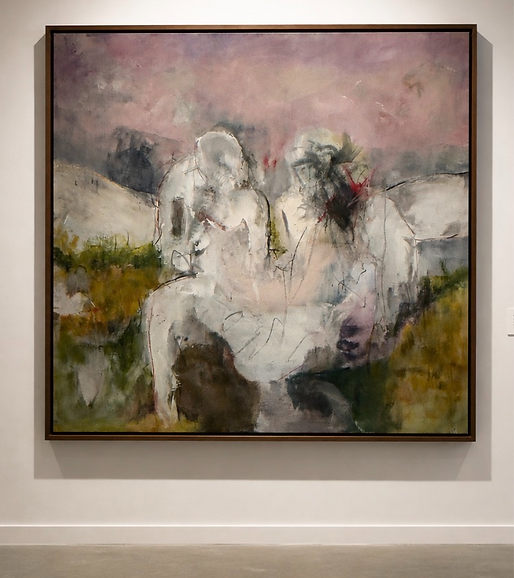
The Last Day of September
2026
Acylics on canvas
122 cm × 122 cm
£4,500
From the Shelter series
Some images never leave us. Glimpsed for a few moments on a phone screen, they become permanently etched into our collective memory.
This painting revisits one such moment: a father and child, huddled together against a wall, seeking refuge from violence unfolding around them. The father's instinct to protect is absolute, yet his ability to do so is heartbreakingly fragile.
The work is not intended as a literal record of an event, but as an exploration of the vulnerability of innocence and the limits of protection.
Part of the Shelter series, it asks what remains of our understanding of safety when even the embrace of a parent cannot provide it.
And what does it say about our humanity that such images can remain with us for decades, while the suffering they represent continues?

They came for the trees
2026
Acrylics on canvas
152 cm x 180 cm
£5,500
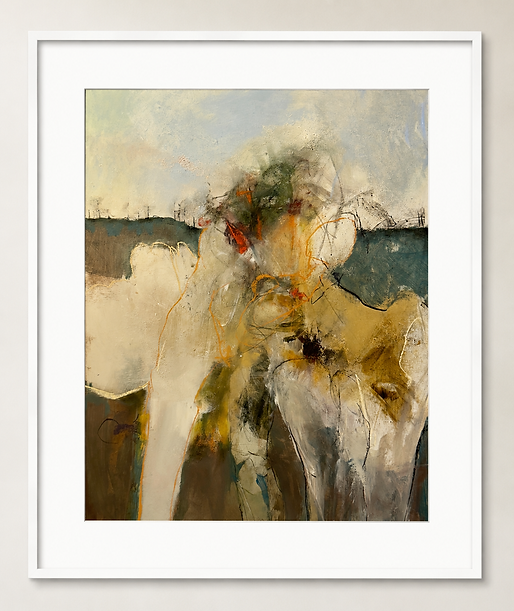
Untitled
2026
Acrylics and Pastel and on Paper
59.5 × 79 cm
£2,500. (Unframed)

Untitled
2026
Acrylics and Pastel and on Canvas
150 × 260 cm

The Morning of May 26th. Displacement Camp
2026
Acrylics and Pastel and on Paper
Sold

Untitled
2026
Acrylics and Pastel and on Paper
Dyptich
£5500

The Shelter
2026
Acrylics and Pastel and on Paper
101 × 81 cm
£2800

Stolen Goods
2026
Acrylics and Pastel and on Paper
81 × 101 cm
£2800

Diaspora
2026
Acrylics and Pastel and on Paper
101 × 81 cm
£3,800
Shelter as both a presence and an absence. This work explores how shelter can be lost, how it's longed for, even how fragile the idea of safety is. The life jackets signal a promise of protection, but the body parts and the fragmentation suggest that that promise is broken.
Shelter as something that is not always guaranteed, but something that's desperately sought after. It's not just a roof or a wall. It's the most basic sense of safety and belonging.
Queer Bodies
These three paintings below explore the tower as a queer body, built from experiences piled on top of one another. Memories, relationships, shame and moments of belonging all become part of the structure. Each layer changes the balance.
Some towers have unfinished foundations. For me, this connects to growing up queer and learning to show the world a version of yourself that feels safer or more acceptable. Having to hide who you are can affect everything you build afterwards. Experiences of abuse and exclusion add further weight; some structures look as though they might fall.
I try to make a painting each week, allowing how I feel to influence its construction. Where I begin, how I prepare and what I leave unresolved become visible in the work. The towers grow organically, their precarious balance reflecting the way our sense of self continues to shift.
Shelter and erasure run through these paintings. I’m interested in what happens when the places meant to protect us fail to do so, and how we find ways to build our own. There is also a wider absence: queer lives and stories that were hidden, silenced or never recorded. These towers carry something of that history, alongside my own experience of finding a place within it.


